The Best Move Is Often No Move

I get some version of this call every few months: a client sees something in the news — a rate decision, an election, a scary headline about the market — and asks whether we should "do something" before it gets worse.
It's a completely human question. Doing nothing while the ground seems to be shifting feels irresponsible. So let's actually look at what "doing nothing" gets you, because the numbers on this are better than most people expect.
Start with the risk side of the equation. Research on individual stocks has found that a single, randomly chosen company has underperformed the S&P 500 over rolling ten-year periods more than 58% of the time. Pick one stock and sit on it, and the odds are stacked against you more often than not.
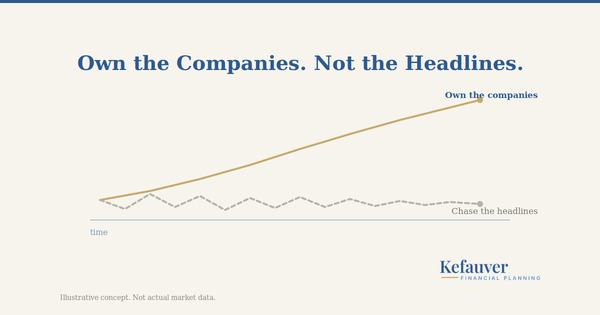
Now flip it. A researcher named Hendrik Bessembinder ran a different experiment: he built "do-nothing portfolios" out of the full basket of S&P 500 companies — buy them all, then simply leave them alone, even as individual names got dropped from the index over the decades. From 1971 through 2025, that hands-off, fully diversified basket compounded at 11.3% annually. The index itself, actively rebalanced and managed, returned 11.2%. Essentially identical.
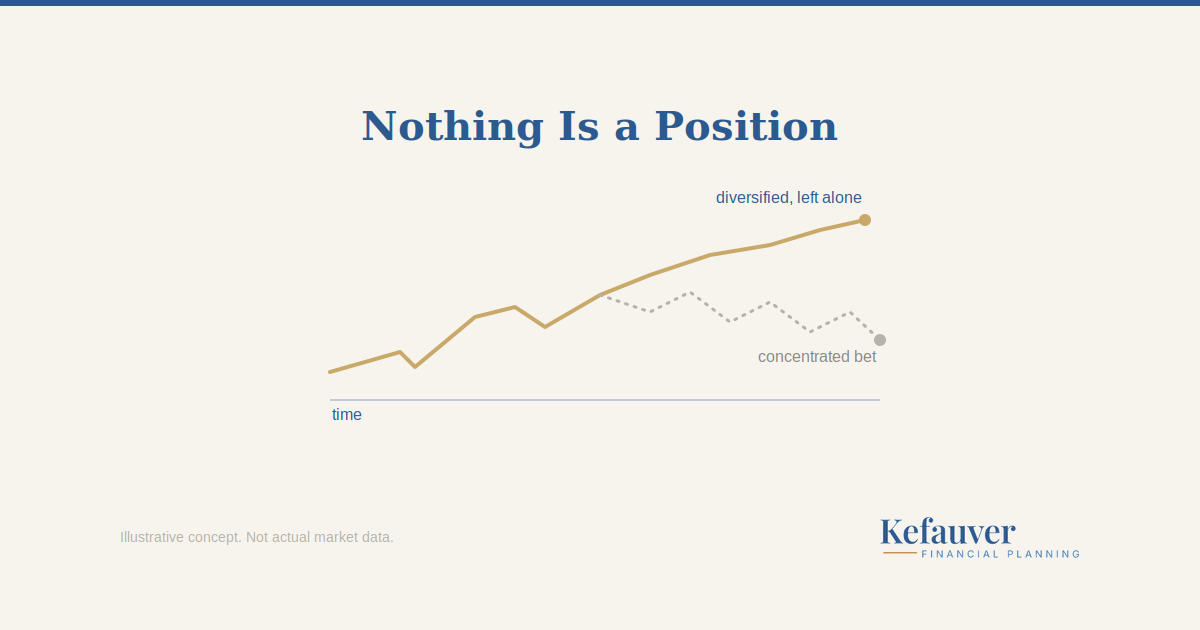
So the single stock, left alone, is a coin flip stacked against you. The diversified basket, left alone, keeps pace with professional management over more than fifty years. The difference isn't activity. It's diversification.
This lines up with something Warren Buffett has said for decades — that inactivity, paired with the right portfolio, isn't laziness. It's the strategy.
Here's the part that's harder to admit: knowing this doesn't make it easy to live by. We're wired for action, and financial media has built an entire business model around giving us reasons to react — to headlines, forecasts, elections, downturns. The gap between what a disciplined investor earns and what the average investor actually earns even has a name in this business: the behavior gap. It's not a knowledge problem. It's a discipline problem.
So next time the phone rings and someone asks whether we should do something — my answer is usually the same one the data supports: we already did the important thing. We built a portfolio to be left alone. Now we leave it alone.