Confidence Isn't Accuracy

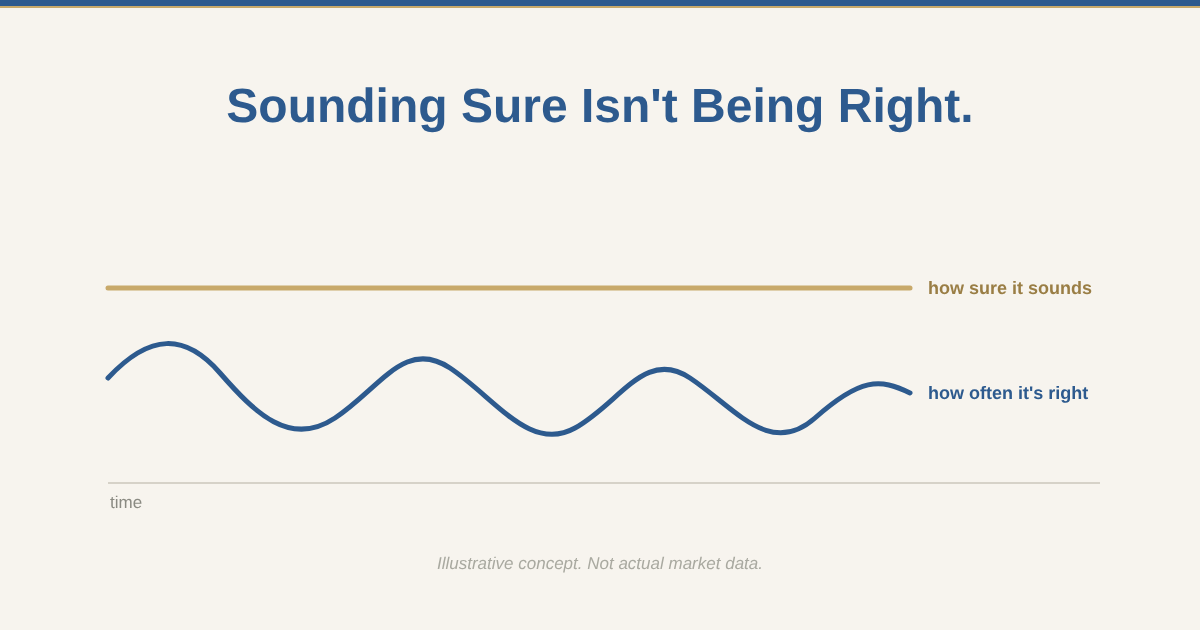
My phone's GPS has never once sounded unsure of itself. Same calm voice whether it's routing me around a traffic jam or straight toward a lake. It's right most of the time, which is exactly why I stopped noticing the times it isn't.
I've been thinking about that because more and more of the money information people run across comes in that same tone. A headline, a pundit, a chatbot. Smooth, certain, no hedging. And the delivery is so polished it's easy to forget the delivery has nothing to do with whether the answer is right.
A recent study out of the UK put that to the test. Researchers ran more than 10,000 personal finance questions through 18 popular AI tools, and on average the answers were wrong more often than they were right. The wrong answers read every bit as confidently as the right ones.
The late Michael Crichton had a name for a related habit - Gell-Mann Amnesia. We catch the errors when a story covers something we know well, then turn the page and trust the next one anyway. I'd add a wrinkle for the money world: most people don't know tax brackets, Social Security claiming rules or Medicare surcharges well enough to spot the mistakes in the first place. So nothing ever triggers the doubt.
How sure something sounds tells you nothing about whether it's right.
That matters more with money than almost anywhere else, because the cost of a confident wrong answer usually shows up years later. A Roth conversion in the wrong year. A Social Security claim filed too early. A portfolio sold in a panic because someone on TV was certain the bottom wasn't in. None of those feel like mistakes the day you make them. They feel like following good advice.
A few habits help. Ask "how would this source know?" before asking "what does it say?" Be wary of any answer with no "it depends" in it, because real financial answers almost always have one. And run anything that changes a big decision past someone who knows your whole situation and has to stand behind the advice.
I'm not anti-technology, and there's a real place for these tools. But I treat them the way I treat that GPS: a helpful voice, not the final word. When it says to drive into the lake, I keep my hands on the wheel.
If something you've read or heard lately has you second-guessing your plan, send it my way. Sometimes the most useful thing I do is tell you which parts to ignore.